
Chickasaw County Arrest Records and Court Charges
An arrest record in Chickasaw County is the account of the arrest itself. It shows who was taken into custody, the officer or deputy who made the arrest, and the booking that followed. Sheriff's deputies, Houston and Okolona city police, and state officers can all make an arrest. The booking side of that record sits with the Sheriff and the jail, not the court clerk. The county does not run an online mugshot or booking blotter. For custody status and jail roster questions, the Chickasaw County inmate records page points to the right phone lines and state tools.
The court charge record is a separate file. After an arrest, the case goes to a prosecutor, who decides what to charge. Those charges after arrest are filed with the court clerk and tracked as the case moves. A charge can be added, reduced, or dropped along the way. The full case file, with pleas, hearings, and the final outcome, lives in the Chickasaw County criminal court records. The charge record is the bridge between the arrest and that final case file.
How to Find Chickasaw County Arrest Records and Charges
Charge records in Chickasaw County are searched through the court system, not a single free county lookup. In Chickasaw County, Circuit Court holds felony charges. Justice Court and Municipal Court hold lower charges and city tickets. Most electronic Circuit and Chancery cases run through Mississippi Electronic Courts, and public users reach them through a PAMEC login rather than an open search.
- Identify the court level, since felony charges go to Circuit Court while smaller charges sit in Justice or Municipal Court.
- Open Mississippi Electronic Courts and sign in through a registered PAMEC account.
- Search by the defendant's name or the case number.
- Open the case and read the charge list, the statute code, and the severity level.
- Check the status flag on each charge to see whether it is pending, amended, or closed.
Arrest and booking detail is not in the court portal. That information comes from the Sheriff or the jail by phone. A statewide criminal history is also held apart from these court files, and Mississippi does not treat it as an open public record.
Note: Many Chickasaw County charges are not online at all, so a call or visit to the Circuit Clerk in Houston or Okolona is often the fastest route.
Who Files Charges After a Chickasaw County Arrest
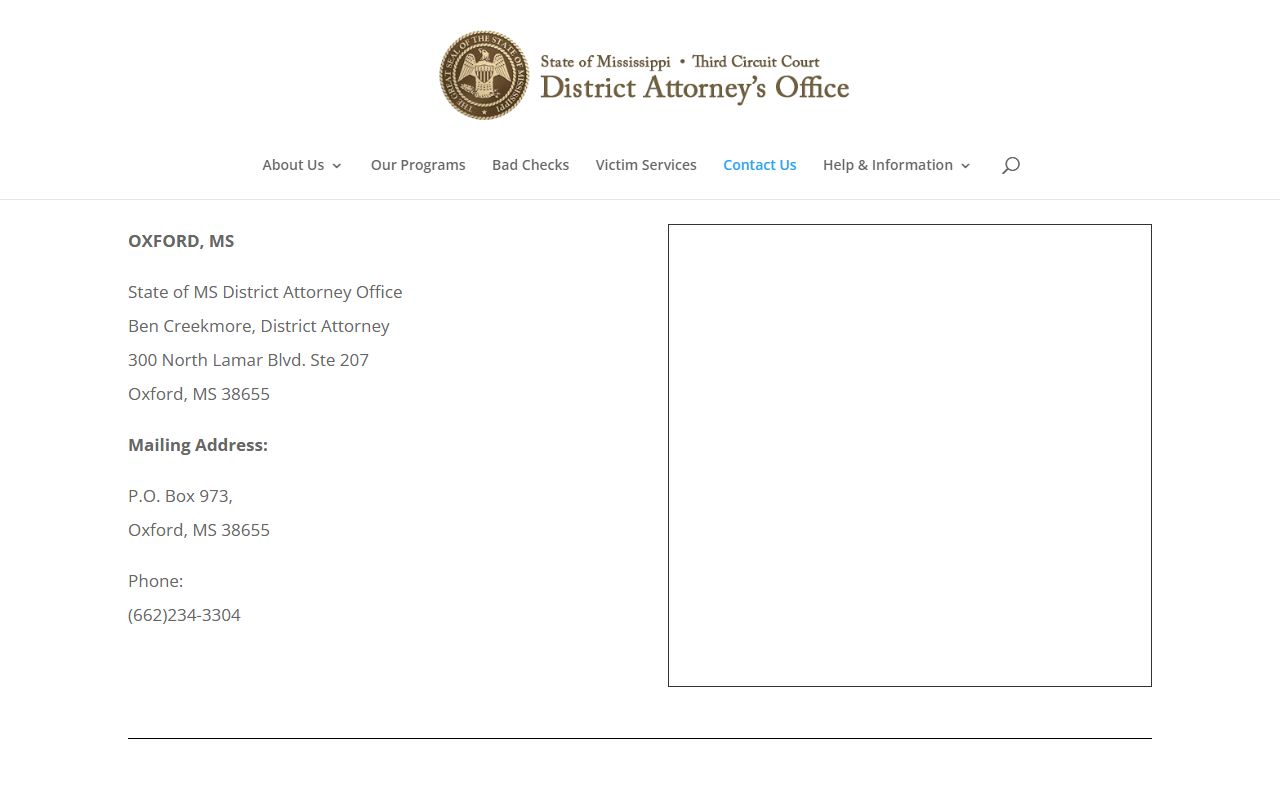
Chickasaw County sits in the Third Circuit District Attorney's Office. That office serves seven counties, including Chickasaw, and it decides which charges to file after an arrest. The District Attorney is Ben Creekmore. The Assistant District Attorney assigned to Chickasaw and Calhoun Counties is Karsunn Moore, who works out of the New Albany office.
The Third Circuit District Attorney lists its offices and direct lines on the district attorney contact page.
That office reviews the arrest, the reports, and the evidence before formal charges reach the Chickasaw County court file. The prosecutor is not bound by the arrest charge. A deputy may book a person on one offense, and the District Attorney may file a different charge, more charges, or none at all. Probable cause supports an arrest. A decision to prosecute is a separate judgment that shapes the court charge record.
How Chickasaw County Charges Get Filed
The court charge record begins when a charging document is filed. The arrest and booking come first. Then one of three papers opens the criminal case in Chickasaw County. The document type depends on how serious the offense is and which body brings the charge.
Local arrests in the county seat often start with the Houston Police Department.
An officer's complaint or affidavit can be the first charging paper before the case moves up to the prosecutor. A complaint, an information, and an indictment each open a case in a different way, as the table below shows.
| Complaint | Information | Indictment | |
|---|---|---|---|
| Filed By | Officer or prosecutor | Prosecutor | Grand jury |
| Common For | Misdemeanors and initial charges | Many felonies | Serious felonies |
| Decided By | Reviewing judge | Prosecutor review | Grand jury vote |
| Starts the Case | Yes | Yes | Yes |
Chickasaw County Pretrial Intervention and Charge Diversion
Not every Chickasaw County charge heads straight to trial. The Third Circuit runs a Pre-Trial Intervention program, authorized by state statute, for non-violent felony offenders. A charge can stay pending while a defendant completes it.
The Third Circuit District Attorney describes its diversion and intervention work on the district attorney programs page.
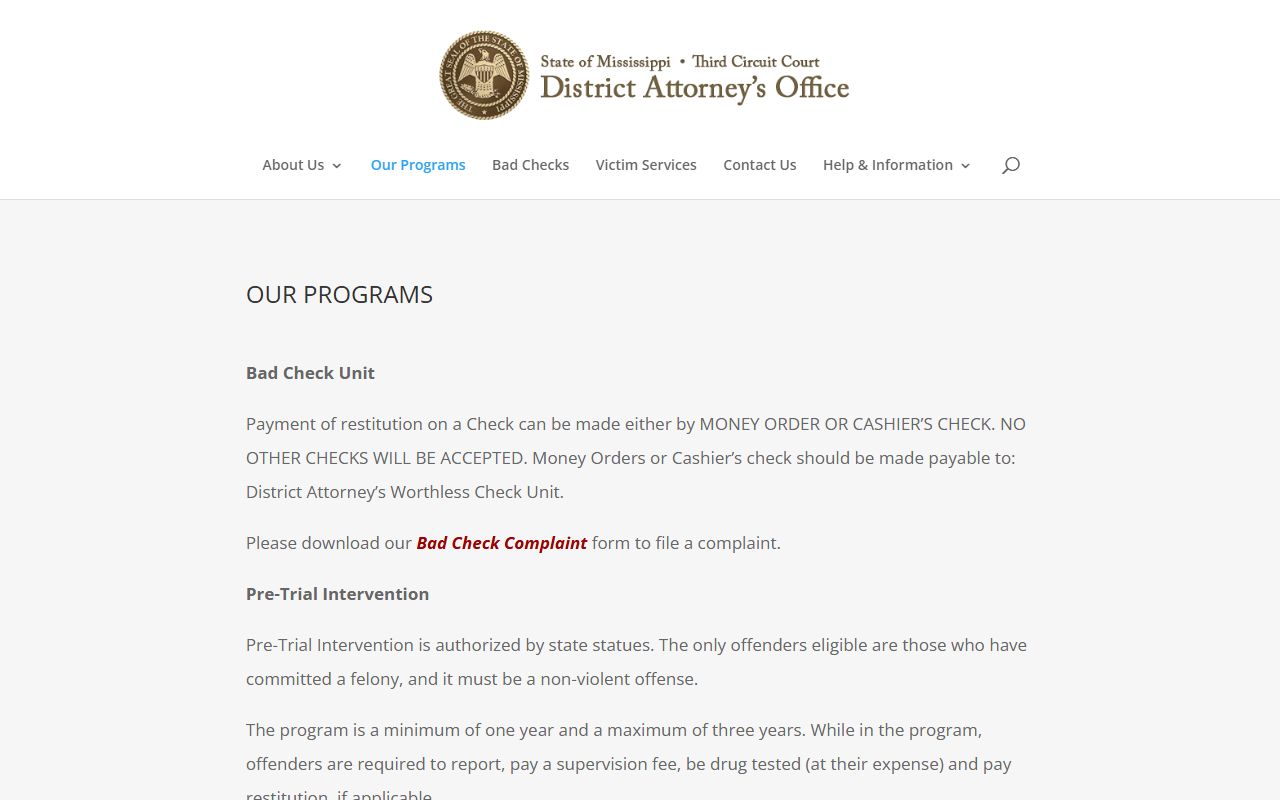
Charges handled this way often show a pretrial intervention status before they resolve. Pre-Trial Intervention runs from one to three years. Participants report in, pay a supervision fee, submit to drug testing at their own cost, and pay restitution when it applies. Finish the program and the charge is dismissed, and it may later be expunged. Fail it, and the case returns to the Chickasaw County docket for prosecution. The same circuit also runs a drug and felony intervention court for eligible drug-related cases, where the District Attorney recommends entry and court staff approve it.
Note: Successful completion of intervention can lead to dismissed and expunged charges, which is one reason an old Chickasaw County charge may no longer appear in a public search.
Charge Status in Chickasaw County Court Records
A charge is not fixed once it is filed. As a Chickasaw County case moves, the status of each charge changes, and the court record uses set terms to track it. Mississippi Electronic Courts flags concepts such as Plea Pending, Nolle Pros Pending, and Capias Pending. Reading those terms correctly keeps a search from being misread.
| Status | What It Means |
|---|---|
| Pending | The charge is filed and the case is open, with no final outcome yet. |
| Amended or Reduced | The charge is changed, often to a lesser offense, before resolution. |
| Dropped | The prosecutor decides not to pursue a charge that was filed. |
| Dismissed | The court ends the charge without a conviction. |
| Nolle Prosequi | The prosecutor formally declines to prosecute the charge further. |
| Bound Over | A lower court sends the charge up to Circuit Court, often after a grand jury. |
Charge Codes and Severity Levels
Each Chickasaw County charge ties to a specific statute. The charge record names the offense and the code section behind it, which fixes what the State must prove. Severity drives almost everything that follows.
Mississippi sorts offenses into felonies, misdemeanors, and minor violations. Felonies are the serious crimes that route to Circuit Court and can bring prison time. Misdemeanors and traffic and ordinance matters tend to stay in Justice Court or Municipal Court. Justice Court handles civil claims up to a set limit, misdemeanor crimes, and traffic cases. One arrest can produce several separate charges at once, and each charge carries its own code, level, and status.
The level set on a Chickasaw County charge shapes the whole path of the case. It decides which court hears the matter, whether a grand jury must act, and how the prosecutor frames the charging document. A felony charge can later be reduced to a misdemeanor, and that change shows in the record as an amended charge. Reading the code and the level together gives a clearer picture than the offense name alone.
Charges vs. Convictions in Chickasaw County
A charge is an accusation, not a finding of guilt. This is the single most misread part of any Chickasaw County charge record. A person can be charged, and the case can still end in dismissal, acquittal, or diversion. The court file shows both the charge and, later, the outcome.
| Charge | Conviction | |
|---|---|---|
| Stage | Accusation filed | Verdict or guilty plea |
| Burden of Proof | Probable cause | Beyond a reasonable doubt |
| Means Guilt | No | Yes |
| Public Record | Yes | Yes |
| May Be Expunged | In eligible dismissed cases | In some eligible cases |
Statewide Charge and Criminal History Limits
County charge records and a statewide criminal history are not the same thing. Individual Chickasaw County charges live in the court file. A full criminal history compiles records from across the state. The Mississippi Department of Public Safety treats criminal-history records as not open to the general public.
Driving records and crash reports are also held apart from court charge files and run through their own Department of Public Safety channels. Expunction under Mississippi Code Section 99-19-71 can remove eligible charges from public view, so some old Chickasaw County arrests no longer surface in any ordinary search.
Important: Chickasaw County Court Records is not a consumer reporting agency under the Fair Credit Reporting Act, and its information cannot be used for employment, tenant, or credit screening.
Victim Services in Third Circuit Cases
Court charges in Chickasaw County affect victims as well as defendants. The Third Circuit District Attorney runs victim services tied to the cases it prosecutes.
The office posts compensation, impact-statement, and rights forms on the district attorney victim services page.
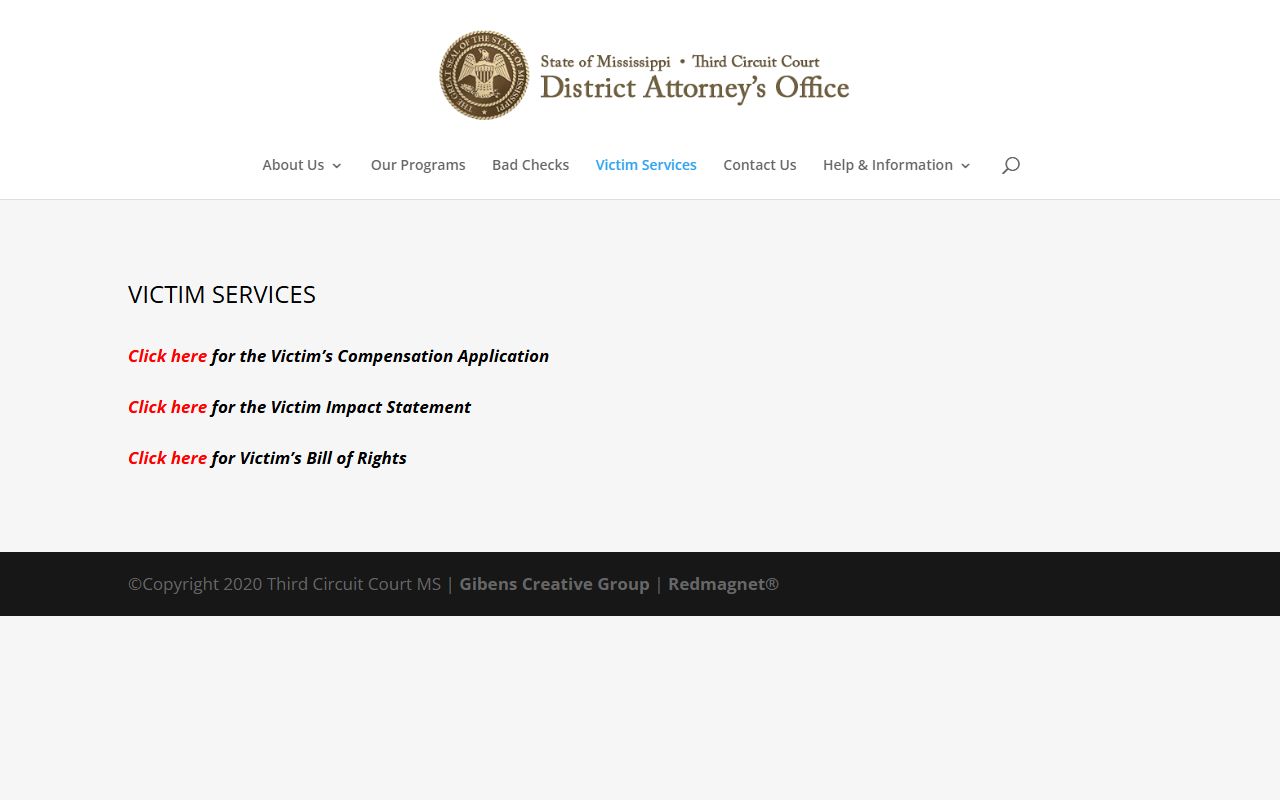
A victim advocate works the Chickasaw County cases and connects people to those forms and to case updates. The advocate can explain where a charge stands and what a hearing means without turning the file into a public lookup. For a person tracking a Chickasaw County charge, the office line is often a faster source of accurate status than any database. The advocate can also point to the compensation claim and the impact statement that a court may consider at sentencing.
Restricted Charge Records in Chickasaw County
Not every Chickasaw County charge record is open. Several categories stay closed by law or by court order, and a public search will not return them.
- Youth Court charges, which are confidential under Mississippi youth-court law.
- Sealed cases, where access needs a qualifying status or a court order.
- Expunged charges, removed from public view once a court grants the petition.
- Investigative reports, which the state holds exempt from ordinary release.
- Criminal-history records, which are not public records through state channels.
Dismissed or dropped charges may also be withheld or later expunged. Confidentiality of youth records rests on Mississippi Code Section 43-21-251. When a record does not appear, the cause is often one of these limits rather than a gap in the data.
Note: Confirm whether a charge is sealed, expunged, or simply offline by asking the Circuit Clerk in Houston or Okolona before assuming the record does not exist.